.svg)
Executive Summary
Modern data centers are evolving from basic facilities housing servers into highly dynamic electrical environments driven by AI workloads, hyperscale computing, renewable integration, and stringent uptime requirements. Traditional engineering approaches based on static one-line diagrams and disconnected operational systems are no longer sufficient to manage these mission-critical facilities.
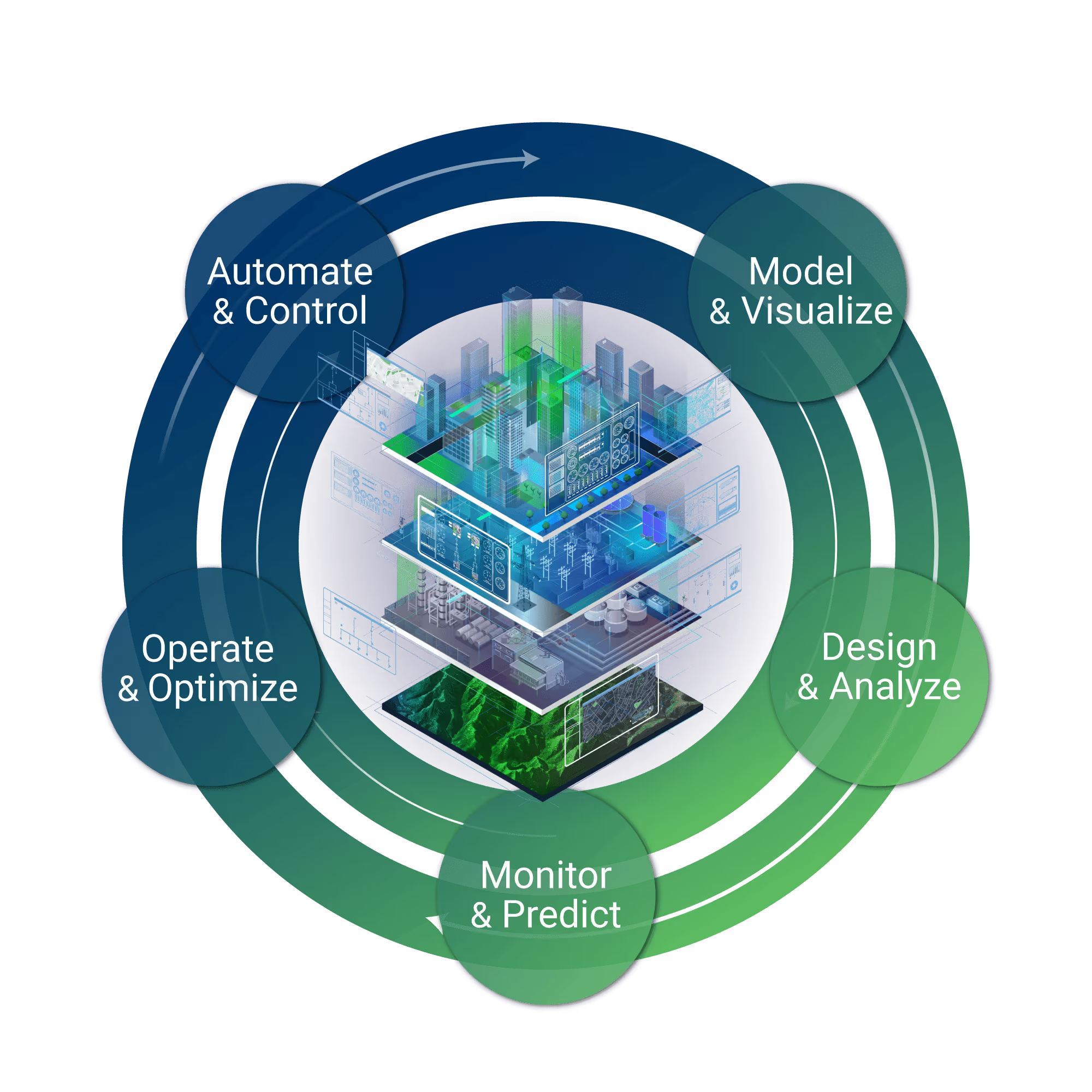
An Electrical Digital Twin (EDT) provides a continuously synchronized virtual model of the electrical power system that integrates design, simulation, monitoring, analytics, and operations into a single platform. ETAP defines the Electrical Digital Twin as a “virtual model of a real-world power system under various physical and operational conditions.” In practice, an EDT enables engineers and operators to test scenarios, identify issues and constraints early, and make decisions using real time data.
For data centers, EDTs improve:
- Reliability and uptime
- Electrical safety
- Operational visibility
- Energy efficiency
- Commissioning quality
- Predictive maintenance
- Grid integration for AI-scale facilities
What Is an Electrical Digital Twin?
An Electrical Digital Twin is a high-fidelity digital representation of the electrical system continuously updated with real time operational data. It replaces static single-line diagrams, and disjointed SCADA and monitoring systems into a single consolidated representative model.
ETAP’s EDT platform integrates:
- Power system modeling
- Load flow and short-circuit analysis
- Protection coordination and Arc flash analysis
- Real-time monitoring
- Intelligent electrical SCADA
- Predictive analytics
- Operator training simulation
In summary, an EDT becomes the single source of truth across design, construction, commissioning, operations, maintenance and future expansion.
E
Key Benefits for Data Centers
1. Improved Reliability and Uptime
Data centers require extremely high availability, often targeting Tier III (~99.982% availability, or about 1.6 hours of downtime per year) or Tier IV (~99.995%, or roughly 26 minutes per year). When interruptions do happen, the impacts can be significant, often costing hundreds of thousands of dollars. EDTs improve resilience through:N-1 contingency analysis
- Failure mode simulation
- Predictive maintenance
- Real-time system visibility
- Faster fault identification
2. Enhanced Power System Engineering
EDTs support advanced electrical studies before energization, including Load flow, Short circuit, Harmonic, Arc flash and Protection coordination studies. Benefits include:
- Improved equipment sizing
- Better selective coordination
- Reduced commissioning risk
- Safer operation
- Digital continuity from design to operation
3. Faster Commissioning and Safer Operations
Digital twins allow operators to validate switching sequences and protection settings virtually before energization. Benefits include:
- Reduced startup delays
- Lower commissioning risk
- Improved operator training
- Reduced human error
- Improved reliability and uptime
4. Energy Efficiency and AI Readiness
AI-driven facilities introduce rapid load fluctuations and very high rack densities. ETAP’s “Grid-to-Chip” digital twin architecture supports dynamic simulation of these environments, enabling optimization of:
- UPS loading
- Battery storage systems
- Renewable integration
- Power Usage Effectiveness (PUE)
- Capacity utilization
Importance for Data Centers in Alberta, Canada
Alberta’s rapid transition into an AI and hyperscale data center region is creating one of the most demanding electrical infrastructure environments in North America. The province of Alberta is emerging as a major hyperscale and AI data center market due to competitive electricity pricing, access to natural gas generation, cooler climate conditions and large-scale AI infrastructure investment.
However, Alberta also faces some challenges including significant grid capacity constraints, rapidly growing AI-related electrical demand, increased renewable penetration and dynamic load variability.
On June 4, 2025, the Alberta Electric System Operator (AESO) held its Phase I: Large Load Integration Information Session and outlined a two‑phased strategy to balance rapid investment with grid safety and reliability. At that time, transmission service requests from large load projects over an 18–24 month window had risen to over 16 GW, compared with Alberta’s peak load of roughly 12 GW.
AESO also established a one‑time, interim limit of 1,200 MW as the maximum additional large‑load capacity that could be served in the near term without negatively impacting reliability. This scale of demand growth is unprecedented in the province and fundamentally changes both planning assumptions and day‑to‑day operational requirements for utilities and data center operators.
Supporting Microgrids and Behind-the-Meter Generation
Due to Alberta’s available transmission capacity being constrained, many hyperscale developers are evaluating:
- Dedicated natural gas generation
- Battery energy storage systems (BESS)
- Renewable Generation Integration
- Private microgrids
- Hybrid energy systems
Industry and policy discussions in Alberta increasingly emphasize data centers providing or procuring their own generation capacity rather than relying entirely on the provincial grid. These architectures significantly increase electrical complexity.
An Electrical Digital Twin becomes essential as part of the design and operation of Data Centers for:
- Island mode simulation and Black-start analysis
- Generator synchronization and Economic dispatch optimization
- Grid-interactive UPS coordination
- Energy storage optimization and Renewable intermittency analysis
- Continuous validation of system redundancy
- Simulation of seasonal operating scenarios
- Constant evaluation of generator fuel resilience
- Prediction of thermal stress on equipment
- Switching optimization procedures during extreme events
Final Thoughts
Electrical Digital Twins are becoming foundational technologies for next-generation data centers. By combining engineering analysis, real-time monitoring, predictive analytics, and operational simulation into a unified platform, EDTs allow operators to move from reactive to predictive and proactive electrical operations.
To learn more about Electrical Digital Twins, contact info@potentialengineering.ca